Tuesday, July 15, 2014

Green Gentians and Mid-summer Color

I've spent the last two weeks in Crested Butte for the Wildflower Festival and the midsummer madness that is Wildflower Season.  While I was up there my tablet decided to quit so I wasn't able to blog.  /the Festival was great.  I lead two wildflower hikes relating the geology to the wildflowers, and a couple other Wildflower Identification hikes.  Any time I get to spend that much time hiking through the woods and meadows, you spot all sorts of interesting things.  

One of my favorite flowers up there, and one that we occasionally see on Green Mountain, is the Green Gentian or Monument Plant.  It's unlike any other gentian, which are usually small purple flowers that bloom in late summer.  This one grows to 6' tall and is covered with four-leafed green blossoms.In mountain meadows you find them blooming fairly commonly, but it's not an easy life for these big showy plants.  

Green Gentians are monocarpic, meaning they flower once and die.  But this flowering happens at the end of a long life, since at high altitudes, or even at our moderate elevation of 6000'+, it takes a long time for the plants to become big enough to flower.  For most of its life, the Green Gentian appears as a bunch of shiny leaves low to the ground.  When it finally has enough strength accumulated, it's bursts forth, producing a shower of seeds to start the cycle over again.  Researchers at the Rocky Mountain Biological Lab (RMBL), in Gothic, Colorado, have watched the same plants as they re-leaf every spring--for over 40 years!  It's thought that many Green Gentians live 60 years before blooming.  Talk about patience!
Green Gentian (Frasera speciosa) waiting patiently
Green Gentian finally blooming!
Now, back to Green Mountain!  After being gone a couple weeks I wasn't sure what the mountain would look like, but it seems the cool (compared to the last few years) summer has kept things looking great.  This year I'mm seeing lots of Purple Prairie Clover, one of my favorites.  When I first saw it several years ago, there was one small patch in a rocky soil in a protected area.  I thought it must be out of its normal range since there was only that small area.  But in the last few years it's spread and this year can be found in many locations.  One of the best is at the top of the John O. Hayden Trail as you contour near the radio tower.  On that stretch the pink Sticky Geraniums, Purple Prairie Clover, Prairie Coneflower and Bush Sunflowers are abundant.  Soon the Liatris (Gayfeather) will add more purple spikes to the landscape.
Purple Prairie Clover (Dalea purpurea) with Golden Asters


Friday, June 27, 2014

Lupine Season

With summer come the Lupine--one of the most celebrated flowers across the country.  In California they're known as Bluebells or Bluebonnets, and in Texas they're the state flower, known as Texas Bluebonnets.  Because they add a bright blue to the scenery as it starts to dry up, they keep Springtime with us for a few weeks longer.

Lupines are members of the  Fabaceae (pea) family.  I've talked about some other members of that family--Vetches, Milkvetches and Locoweed.  Peas are great for the soil since they take nitrogen from the air and 'fix' it in the soil, giving nutrients for other plants.  

Lupines are pretty plants even before they bloom.  The leaves are digitate or palmate, so they come out from one central point like the fingers of a hand.  Early in the season that's all you can see, but they're distinctive, and are a sign that summer will come.
Lupine (Lupinus argentum)
The flowers on peas are pretty cool, too.  They have distinctive names, but mostly it's the over all shape that's important in identifying them.  There are five petals, but the two lower petals are fused into one and form a round, pointed shape which is named a keel.  The two petals on the sideAbove the keel, are two petals that flare out to the side, called wings.  The last petal sits on top and is called the banner.  All peas have a similar arrangement, from the wildflowers to the peas in your garden.  Likewise, after the blooms, the seeds of the Lupine looks like little fuzzy pea pods.  Check them out!

Closeup of Lupine flowers

Friday, June 20, 2014

Some new guys

One of the fun things about tracking wildflowers is that it seems there's always something new.  I've been doing this for 12 years on the mountain, just out of curiosity, but each year I find something new.  Was I just not looking closely, bad timing, or is a nw species looking for a home?

I can answer that question sometimes.  My neighbor said shed found an interesting new plant in the open space behind our houses.  Since that area was scraped for planned development in the '60's, nothing in there is in its original High Prairie condition, so I was suspicious.  Sure enough, the mystery plant is Houndstongue, a noxious weed I'd seen in the mountains, but never down here.  The state has it classified as List B, so although they don't have a plan to eradicate it, they ask anyone who has it on their property to control it.
Houndstongue (Cynoglossum officinale)

The second is much more likable.   Two weeks ago I spayed it near the Utah trailhead, but since then I've found it in three other pace, widely separated, all over the mountain.  This one is called Pony Beebalm, and is a pretty little mint.  
Pony Beebalm (Monarda pectinata)
Keep your eyes open...you never know what'll pop up.

Sunday, June 15, 2014

Microclimates

One of the things that's always fascinated me about Green Mountain is how this 1000' hill can create its own weather.  Numerous times as I'd drive home on 6th Avenue, it would be raining as I got off the freeway, but by the time I had driven another couple miles and gone up a couple hundred feet, we were in a blizzard.

The same thing makes for some interesting places to look for unusual wildflowers.  One of my favorites is Coyote Creek, the name we gave the drainage just west of the water tank at the end of Virginia Drive on the north side of the mountain.  (There were coyote pups being raised there our first summer here.)   This drainage faces north and is steep, so it's well shaded.  It's about the only place on the mountain where aspens, maples and hops can be found.  There are a few others, like False Solomon Seal and Poppy Mallow can be found.  These are usually found higher in the foothills.
False Solomon Seal or Wild Lily of the Valley (Maianthemum stellatum)
There are lots of spots where the wildflowers are more prolific that aren't quite as dramatic as this.  Most of them involve a north-facing slope, so the moisture is retained a little longer in the soil.  Other areas are dry enough to provide a different mini-environment such as some of the exposed areas on the south side where the Mountain Ball Cactus thrive.  Some of these spots are the first to warm up in the Spring, so the early flowers will be out there first.


As far as what's new on the mountain the week, Mariposa Lilies and Prickly Poppies are out in abundance.  These will be around for a few weeks and are some of the most interesting of the summer blooms.  
Mariposa (or Sego) Lily (Calochorus gunnisonii)


Prickly Poppy (Argemone polyanthemos)

Sunday, June 8, 2014

Meanwhile, up in the hills...

I had a chance for a Spring visit to Crested Butte last week, and with the big snows melting off, it looks like a spectacular wildflower season.  This earlier varieties of flowers are shorter, but they are abundant.  The Glacier Lilies and Spring Beauties cover big areas, making the ground yellow and pink.  Things like Columbine aren't blooming yet, but there's lots of larkspur and the lupine are opening up.

The Crested Butte Wildflower Festival will be held July 6-12.  There are lots of planned hikes during that week, but any time in July can be considered the high season for flowers.  If you go, you can pick up information on where to go and wildflower identification guides at the information center in town.
Glacier Lily (Erythronium grandiflorum)
Back on Green Mountain we've seen the first of the sunflower varieties coming out.  This signals the start of the summer flowers to me.  These are members of the Aster Family, and are really complex flowers even though they're so familiar.  Each of the petals lining the bloom is actually a flower in itself, called a ray flower.  Think of the rays of the sun. In the "pincushion" in the center are hundreds more flowers, called disk flowers.  When you see a sunflower with all the seeds in the center, each seed came from one flower.  If you get a magnifying glass you can see that each one has its own flower structure to it.  

Blanketflower is one of the prettiest we have on Green Mountain, and I've see several of them blooming this week.  There are a few Bush Sunflowers, too.  These have centers that are yellow, as opposed to the Common Sunflowers which should be out in a week or two.  Those have dark brown disk flowers.
Blanketflower (Gaillardia aristata)

Sunday, June 1, 2014

The Height of Wildflower Season

The combination of rainfall and sunshine that we've had over the last couple weeks has turbo-charged the wildflower season on Green Mountain.  A couple weeks ago we were having a good season, but were still seeing a lot of the early flowers and barely starting to see things like Penstemon and Locoweed.  In the last few days, the 80 degree temps have brought the mid-season flowers out and the rains have kept the early bloomers intact!

I mentioned that the Wild Onion and Death Camas were kind of hard to find.  Since then I've seen them al over, more onions than camas, but if you look closely for the little guys there are lots of them around.  

One of the other wildflowers we don't see too often on the mountain is going wild this year.  These are the Spiderworts, which are blooming in big healthy plants on the south side of the mountain. These are great flowers for your garden, too.
Western Spiderwort (Tradescatia occidentalis)
The following is a quick list of some of the more prominent wildflowers blooming this week on Green Mountain.  I spotted 79 species in a couple hikes and runs on the mountain, but these are the ones you're most likely to spot by color and common name.

Blue:  Blue Mist Penstemon; Chiming Bells; Flax;
Purple: Silvery Lupine; Spiderwort
Magenta: Locoweed
Orchid: Orchid Beardtongue Penstemon;
Pink: Sticky Geranium; 
Yellow: Golden Banner (a few left); Bush Sunflower; Butter and Eggs (Toadflax); Leafy Cinquefoil (looks like Potentilla); Whiskbroom Parsley
White: Drummonds Milkvetch; Prickly Poppy; Wild Onion; Mouse Ear Chickweed;

Those are a few of the most prominent--lots more to see!

Sunday, May 25, 2014

Lilies in the Fields

The plant world is divided into many parts, but the first main divisions between Gymnosperms (pines and the like) and Angiosperms, plants with fruits enclosing their seeds.  Of the Angiosperms we have monocots and dicots.  The monocots are mostly grasses but also include things like onions and lilies.  These are the plants I'll talk about today.  

The term monocot refers to the way the plant starts growing.  When you picture the beans or morning glories coming up in your garden, the first leaves (or cotyledons) that grow from the stem are in pairs.  That's a dicot--two cotyledons.  The monocots have only one leaf that comes out of the seed--like a grass.  Lilies, onions and grass all grow that way.  In addition, when their leaves are larger they are long and have veins that are parallel to the length of the stem.  Dicots can have really complicated leaf structures--picture an oak or maple leaf.

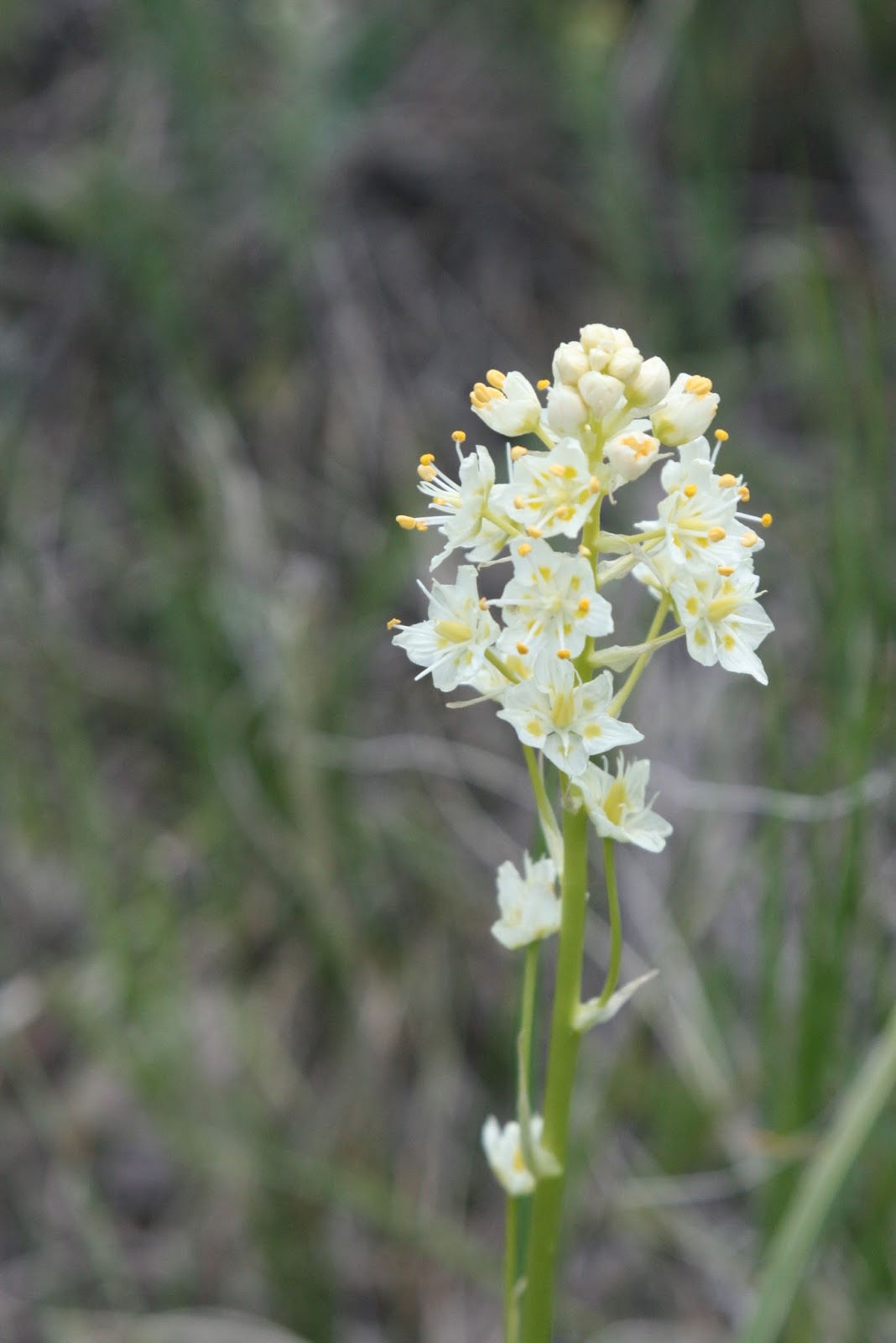
I've talked about Sand Lilies (Leucocrinum montanum), one of the harbingers of Spring (See April 13 entry).  Last week I saw a less common, but really cool little lily blooming--Meadow Death Camas (Toxicoscordion venous).  I've never seen these near a trail, always in the untrammeled meadows on the mountain.  As the name implies, they are poisonous, but pretty little flowers.
Death Camas (Toxicoscordion venous)
I haven't seen any onions yet this year, but they should be coming out soon.  They're a small, chive sized plant that grows all over the mountain, but you'll have to keep your eyes peeled for it.  This one is Allium textile, aka Wild Onion.  Later in the year you might see a Nodding Onion (Allium cernuum).  These have flower umbels that fall over, or nod, and the flowers are a light pink or lavender color.  
Wild Onion (Allium textile)
I haven't ventured out into the muddy Open Space since the storms of last Saturday night.  Hopefully they didn't beat up the wildflowers too much--we were off to a great start!