The Bureau of Land Management and Jeffco Parks will be teaming up this Saturday, May 17, to lead a wildflower hike. The hike will begin from the Florida trailhead parking lot at 10:00 am and will last about 2 hours. No dogs, please. It should be warm so bring water, sun protection and comfortable hiking shoes. For more information or to sign up, call 303 697-6259.
See you there!
Thursday, May 15, 2014

Saturday, May 10, 2014
Before the storm
With a storm coming tonight Green Mountain will probably be turning white. The micro-climate we have up here always amazes me. It may be raining at 6th and Union, but it'll be snowing a couple hundred feet up the mountain. Since they're calling for 9" of snow I tried to beat the afternoon showers and am amazed at how many flowers have come out in the last week.
The first of the Penstemons, Blue Mist Penstemon, is blooming in a few places and Lupine are blooming on the lower parts of the mountain. There were even a few Hens-and-Chickens cactus (or choose your own favorite name) with their yellow blooms.
One flower that I always associate with higher altitudes is Pussytoes. I'd seen some dead blossoms a couple times in one small area on the east-facing valley above the water tank at the end of Exposition Drive. This year the Pussytoes cover big patches of the south side near the top of the valley. Last week I saw another unusual bloom in the same area, Northern Rockjasmine. It's pretty small and the iPhone photos don't do it justice!
There are several spots on the mountain that have exposure that's just different enough to get a few unusual blooms. I like see ing the hillsides covered with Golden Banner, but it's finding these unusual guys that really makes my day!
The first of the Penstemons, Blue Mist Penstemon, is blooming in a few places and Lupine are blooming on the lower parts of the mountain. There were even a few Hens-and-Chickens cactus (or choose your own favorite name) with their yellow blooms.
 |
Hens and Chickens Cactus (Echinocereus viridiflorus)
|
One flower that I always associate with higher altitudes is Pussytoes. I'd seen some dead blossoms a couple times in one small area on the east-facing valley above the water tank at the end of Exposition Drive. This year the Pussytoes cover big patches of the south side near the top of the valley. Last week I saw another unusual bloom in the same area, Northern Rockjasmine. It's pretty small and the iPhone photos don't do it justice!
 |
| Northern Rockjasmine (Androsace septrionalis) |
 |
| Pussytoes (Antennaria rosea) |
There are several spots on the mountain that have exposure that's just different enough to get a few unusual blooms. I like see ing the hillsides covered with Golden Banner, but it's finding these unusual guys that really makes my day!
Sunday, May 4, 2014
An early Spring
Last weekend was a busy one but the last 10 days have put us right into wildflower season. When I was out a week ago the scent of the chokecherries was already heavy in a few spots. In the last week we've had all the flowering bushes come out--hawthorns, cherries, and plums are the showiest, but the currant bushes and sumac have blossoms all over them, too. That'll make for some happy bees!
This week the wildflowers have really taken off, too, but that's what a warm week will do. We're a couple weeks ahead of last year--remember all the snows through April--so we may hit our peak before Memorial Day.
I have one spot where the Chiming Bells bloom early, and they were out a week ago. This week they're all over the mountain, along with a few locoweed. That adds a lot more color to the yellows of the alyssum and Golden Banner that have been dominating. There are lots of others to watch for, too--Mouse-ear Chickweed, Easter Daisy, Sand Lilies and some Mountain Ball Cactus that are still blooming. Lots to see!
 |
| Chokecherry (Prunus virginiana) |
I have one spot where the Chiming Bells bloom early, and they were out a week ago. This week they're all over the mountain, along with a few locoweed. That adds a lot more color to the yellows of the alyssum and Golden Banner that have been dominating. There are lots of others to watch for, too--Mouse-ear Chickweed, Easter Daisy, Sand Lilies and some Mountain Ball Cactus that are still blooming. Lots to see!
 |
| Chiming Bells (Mertensia lanceolata) |
 |
| Locoweed (Oxytropis lambertii) |
Saturday, April 19, 2014
Red Rocks Trail
I monitor some plants over at Mathews-Winters Park so I took the opportunity to cruise the Red Rocks Trail on Friday. Lots of low wildflowers coming out over there, and it's surprising what a difference a few miles makes.
Geologically the two areas are very different. Green Mountain is made up of sandstone, conglomerate and a little shale. It's a real hodgepodge and isn't very fertile ground. On the west side of the hogback everything is made up of weathered granite--the Fountain Formation of Red Rocks is a deposit formed in the Pennsylvanian Period (~250 million years ago) when the granite-cored mountains were eroded. Often on the Red Rocks Trail, you're walking on the granite itself. Soil made up of eroded granite is much more acidic and provides soil for a wider variety of plants.
Hiking north, the first mile or so is pretty warm and dry. You'll see Cranesbill and Yellow Alyssum all over like a ground cover. As you get into the drainages, though, lots more spring flowers can be spotted.
There were lots of Spring Beauties, a few pockets of Easter Daisies, and even a couple Pasqueflowers, which Ive never seen on GM. Another plant that is really uncommon on Green Mountain is Grape Holly, which is blooming in abundance on the Red Rocks Trail. There were only a couple of the Sand Lilies I talked about last week although they're all over Green Mountain right now.
I'll leave you with a couple Eastery flowers. Enjoy the Spring weather!
Geologically the two areas are very different. Green Mountain is made up of sandstone, conglomerate and a little shale. It's a real hodgepodge and isn't very fertile ground. On the west side of the hogback everything is made up of weathered granite--the Fountain Formation of Red Rocks is a deposit formed in the Pennsylvanian Period (~250 million years ago) when the granite-cored mountains were eroded. Often on the Red Rocks Trail, you're walking on the granite itself. Soil made up of eroded granite is much more acidic and provides soil for a wider variety of plants.
Hiking north, the first mile or so is pretty warm and dry. You'll see Cranesbill and Yellow Alyssum all over like a ground cover. As you get into the drainages, though, lots more spring flowers can be spotted.
There were lots of Spring Beauties, a few pockets of Easter Daisies, and even a couple Pasqueflowers, which Ive never seen on GM. Another plant that is really uncommon on Green Mountain is Grape Holly, which is blooming in abundance on the Red Rocks Trail. There were only a couple of the Sand Lilies I talked about last week although they're all over Green Mountain right now.
I'll leave you with a couple Eastery flowers. Enjoy the Spring weather!
 |
| Pasqueflower (Pulsatilla divaricarpa) |
 |
| Easter Daisy (Townsendia hookeri) |
Sunday, April 13, 2014
Good Early Season Trails
As I sit here watching the snow blow, I'm reminded once again that it will still be a few weeks before all the trails are reliably dry. I thought I'd be smart one day last week and run on the south side. The first half-- up from Florida trailhead-- was dry, but coming down toward the Utah trailhead I hit some spots that were pretty sloppy.
This time of year, staying low seems to be the best bet since all the ravines higher on the mountain can be shady and stay muddy for a week after the snow melts.
One of the best, and easiest places to check out the early wildflowers is the connector trail between the Utah and Florida trailheads. This short segment was realigned a couple years ago and cuts right through one of the best areas for diverse blooms. If you continue east from the Florida parking lot, you can do an out-and back with great views of the city and some different wildflowers than you'll find on the sunnier south side.
A little warm weather really spurred the flowers to come out in the last week. Most of the blooms are just getting started but I've seen Easter Daisy, Golden Banner, and Early Purple Vetch along with a bunch of Sand Lilies. It looks like we'll be warming up slowly over the next week. That'll encourage the flowers to come out but not bloom and drop the way hot weather can make them do.
This time of year, staying low seems to be the best bet since all the ravines higher on the mountain can be shady and stay muddy for a week after the snow melts.
One of the best, and easiest places to check out the early wildflowers is the connector trail between the Utah and Florida trailheads. This short segment was realigned a couple years ago and cuts right through one of the best areas for diverse blooms. If you continue east from the Florida parking lot, you can do an out-and back with great views of the city and some different wildflowers than you'll find on the sunnier south side.
A little warm weather really spurred the flowers to come out in the last week. Most of the blooms are just getting started but I've seen Easter Daisy, Golden Banner, and Early Purple Vetch along with a bunch of Sand Lilies. It looks like we'll be warming up slowly over the next week. That'll encourage the flowers to come out but not bloom and drop the way hot weather can make them do.
 |
| Sand Lily (Leucocrinum montanum) |
 |
| Golden Banner (Thermopsis divaricarpa) |
Sunday, April 6, 2014
A New Year!
It's been a long winter and we're all ready for Spring. Hopefully we've seen the last of the white stuff, but there have been enough steady snows that Green Mountain should have a good base of moisture to bring us a great wildflower season.
This is a fun time of year for me because things change so fast on Green Mountain. Last week there were a few Yellow Alyssum and Storksbill, but they're all over now along with some other more noticeable flowers. Especially along the lower parts of the trails on the south side, some Golden Banner and a couple Early Purple Vetches are adding color to the trails. If you look under the sagebrush you can find a few Yellow Violets, too. I even saw a few lupine leaves coming up. They won't bloom for another 6 weeks or so, but I like seeing the signs!
Enjoy the great weather over the next week and try to avoid the mud!
 |
| The tiny Yellow Alyssum (Alyssum simplex) The four petals tell you it's part of the Mustard Family. |
This is a fun time of year for me because things change so fast on Green Mountain. Last week there were a few Yellow Alyssum and Storksbill, but they're all over now along with some other more noticeable flowers. Especially along the lower parts of the trails on the south side, some Golden Banner and a couple Early Purple Vetches are adding color to the trails. If you look under the sagebrush you can find a few Yellow Violets, too. I even saw a few lupine leaves coming up. They won't bloom for another 6 weeks or so, but I like seeing the signs!
Enjoy the great weather over the next week and try to avoid the mud!
Thursday, October 3, 2013
Berries in the Fall
The wildflowers are fading fast and all the critters on the
mountain are getting ready for winter.
There’s plenty of food in the grasses and seeds and some of the fruits
left on shrubs provide some color for the landscape.
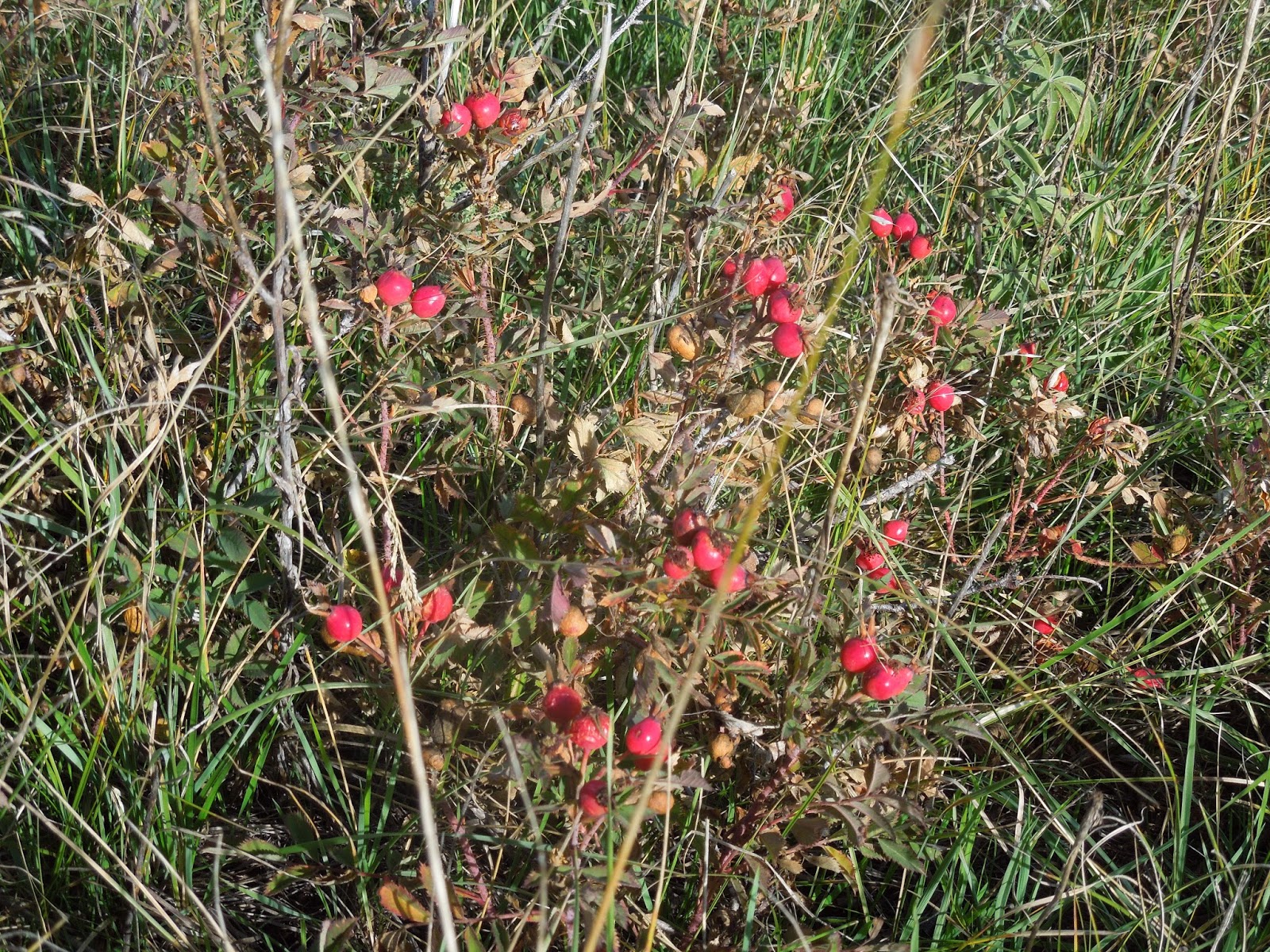
Rose hips on the Wild Roses (Rosa woodsii) have turned bright red and will provide a nutritious
food source for the winter. They’re high in vitamin C and you can infuse them
to make a tea. With the reds and yellows
in their leaves, it makes for some bright red accents in the brown mountainside!

Chokecherries (Prunus
virginiana) are a big food source for birds. These shrubs have loads of white flowers in
the Spring which results in lots of dark purple berries in the late summer and
fall. They’re popular with the birds,
though, and can get stripped clean early in the winter. Chokecherries have been used in jams, but
they’re pretty tart. If you try one,
you’ll feel your mouth pucker up. Native
Americans combined the berries with dried buffalo meat to make pemmican, a
powerbar for their time—lots of energy and easy to keep.

The other berry you’ll see lots of this time of year is the
Snowberry. There are a couple varieties,
Symphoricarpos albus and S.
occidentallis. both small
shrubs. As the name implies these are
the round white berries you’ll see on small shrubs in shady areas of the
mountain. The flowers bloom all through
summer, so the berries can be found from July on. They aren’t so edible, however, being
described as “mildly toxic”. Although
deer browse on the shrubs, I won’t be making any berry pies from them, so enjoy
them for their looks!
This is a good time of year for the animals on the
mountain—time to stock up. When heavy
snows come it becomes difficult to browse and find food, so now’s the time to
fatten up!


Subscribe to:
Posts (Atom)