Thursday, June 25, 2015

Perfect time to smell the Daisies!

If you're planning to get a look at wildflowers on Green Mountain this summer, this is the time to do it. We're finally getting the payoff for all the rain in May. Many hillsides are bright with color. On the North side we're covered in Yellow Sweet Clover (Melilotus officinale)  which isn't great since it's an invasive plant, but the color's nice! The South Side has more Spiderwort (Tradescantia occidentalis) than I have ever seen, and they're big, healthy plants with their deep purple triangular flowers. 

You'll find some white Larkspur (Delphinium carolinium), which is taller than the purple Larkspur we had earlier in the Spring. These can stand 2-3' tall and may have small purple spots on them.

One of the cycles I've enjoyed watching this year is in a really simple group of daisies called the Fleabanes. They are in the Asteraceae (sunflower) Family and all are in the Erigeron species. They look nearly identical--small white daisies with yellow centers--but they have a few characteristics that distinguish them.

The earliest is Sprawling Fleabane, Erigeron tracyi, which is one of the earliest wildflowers. It has a very simple form, a stem that may reach 6" or so with one flower on the end. The leaves are nearly all basal. There may be a couple small ones near the base.
Sprawling Fleabane

As the Sprawling Fleabane start to fade in the heat, Spreading Fleabane (Erigeron divergens). starts to bloom. These have flower heads that are slightly larger, but the plant is definitely bushier, with lots of leaves on the stems.

Spreading Fleabane

If you go up on the trails right now, you'll see big patches of white Fleabane on the hillsides. These are Whiproot Fleabane (Erigeron flagellaris). These are the most interesting in the way they spread--they send out long stolons across the ground, which root to form new plants. Stolons are a type of stem that can form roots, and thus a new plant. This is why we see Fleabane in big patches this time of year.

Whiproot Fleabane
You may be wondering about the name Fleabane. The flowers were used to repel fleas, so it is the bane of fleas. Daisy refers to the bright gold disk in the center of the buds, which looks like the sun--or the "Day's Eye." Erigeron is from the Greek, meaning "old man, because of the gray wispy "hair" on top of the flower as the seeds ripen. 

Incidentally, the common names I give may vary depending on which guidebook you may be using. That's why I provide the genus and species name, too. Those should be more reliable, although they can change as DNA research turns up new twists in plant genealogy!

Friday, June 12, 2015

Evening Primrose on the Mountain

If you have a chance to see Green Mountain through the rain, you'll see wildflowers at their peak this weekend.  As I write this the rain seems to be letting up and the weekend is supposed to be drier so I hope you can get out and enjoy it.

I was at the Florida trailhead on Wednesday morning, and there were so many flowers blooming in that area that it was tempting to just hang out there. The trail to the south from the parking lot is a great place to see lots of variety without much walking. About 100 yards around the trail is a rocky spot that harbors Stemless Evening Primrose (Oenothera caespitosa). They seem to really like the cobbly rock on the hillside to the west and grow right out of the rock. If you're there after noon you may only find the fading flowers from the morning, as they change from bright white to pink. Another variety of Evening Primrose, Hooker's (Oenothera hookeri) blooms on the west side of the mountain. I've seen it near the Rooney trailhead and on Dinosaur Ridge, but never on the east side. As its flowers fade, they turn bright orange. Both of these flowers are easy to recognize by their four petals, and four anthers and prominent stamen in the center of the flower.

Stemless Evening Primrose

 Another variety of Evening Primrose, Hooker's (Oenothera hookeri) blooms on the west side of the mountain. I've seen it near the Rooney trailhead and on Dinosaur Ridge, but never on the east side. As its flowers fade, they turn bright orange. Both of these flowers are easy to recognize by their four petals, and the prominent anthers and four-parted stamen in the center of the flower.
Hooker's Evening Primrose
One last member of this family that is blooming now on Green Mountain is smaller and harder to notice. It's called Scarlet Gaura (Gaura coccinea).  It only stands about 6-8" tall and the scarlet color is muted--it looks mostly white. But it is an interesting little flower, sometimes called Beeplant, because of the pollinators it attracts. Look for it on the trailsides as you're hiking!


Scarlet Gaura

Friday, May 29, 2015

Jolly Green Gentians

It looks like we're finally out of our wet cycle and can start enjoying summer. I was able to get on a couple trails for the first time this year and found some great bloomers! As I mentioned last week, there's still a wide range of flowers out there from the earliest ones that are usually done by now to the late Spring flowers that we usually see this time of year.

I came down the Box o' Rox trail and found some Green Gentians, also known as Monument Plant or Elkweed. I don't see these on Green Mountain every year but they're a really interesting plant. They can live for over 60 years and only flower once. For the first 3-4 years they start developing roots without sending up any leaves. As they save up their strength, they produce a rosette of leaves, that is, a group of shiny long (10-12") leaves coming from a central spot. Finally, after years of growth, they have enough energy to produce a flower and it's a cool one. The stalk can be up to 7' tall. The plants I saw today are about 3' tall, but are still growing. The flowers are white and green and have four petals in a distinctive cross shape, with four green pointed sepals between the petals. Interesting plant--I'm really surprised to see it blooming so early.
Close-up of Green Gentian or Monument Plant


These are the Green Gentians along the Box o' Rox Trail on 5/29
Just above the tall middle flower you can see a rosette of leaves which will produce flowers in some future Springtime!

Sunday, May 17, 2015

Everything's bustin' out

We finally have the May weather we've been looking for and as I look up at Green Mountain this morning it's all blue sky and green grass.  The wildflowers are spectacular right now and I'm hoping to get one more run across the top to check it out before leaving town for a few days. 

We had about 35 people show up for wildflower hikes yesterday. We had a great morning with interesting hikers and lots of variety on the trail. My group hiked from the main parking area west to the Utah Ave. parking and spotted over 30 different flowers. (I wasn't keeping count!) Thanks to everyone who came out!

This year really shows how one family can benefit from a weather pattern. We have lots of different peas (Fabaceae is the official name) blooming. The earliest are still out--yellow Golden Banner (Thermopsis rhombifolia) and purple Short's Milkvetch (Astragalus shortianus). Drummond's Milkvetch (Astragalus drummondii) is the white bushy flower that's all over the hillside. There's also Locoweed (Oxytropis lambertii), one of the most distinctive
of the peas, it's bright fuchsia flowers brightening the trail.


Lambert's Locoweed
The moisture we've had for the last couple weeks (>3" on our rain gauge) has really lengthened the season for the early flowers while the mid-Spring blooms are still coming out a little earlier than usual. 

Penstemons are reaching their peak, with the lavender One-sided Penstemon (Penstemon secundiflorus) in sunnier areas and the little Blue Mist Penstemon (P. virens) dominantly on the north side of the mountain.  

Paintbrush (Castilleja integra) and Bladderpods (Physaria montanum and vitulifera) and Cinquefoil (Drymocallis fissa) add their bright orange and gold to the scene.

Everyone's favorite--Paintbrush 
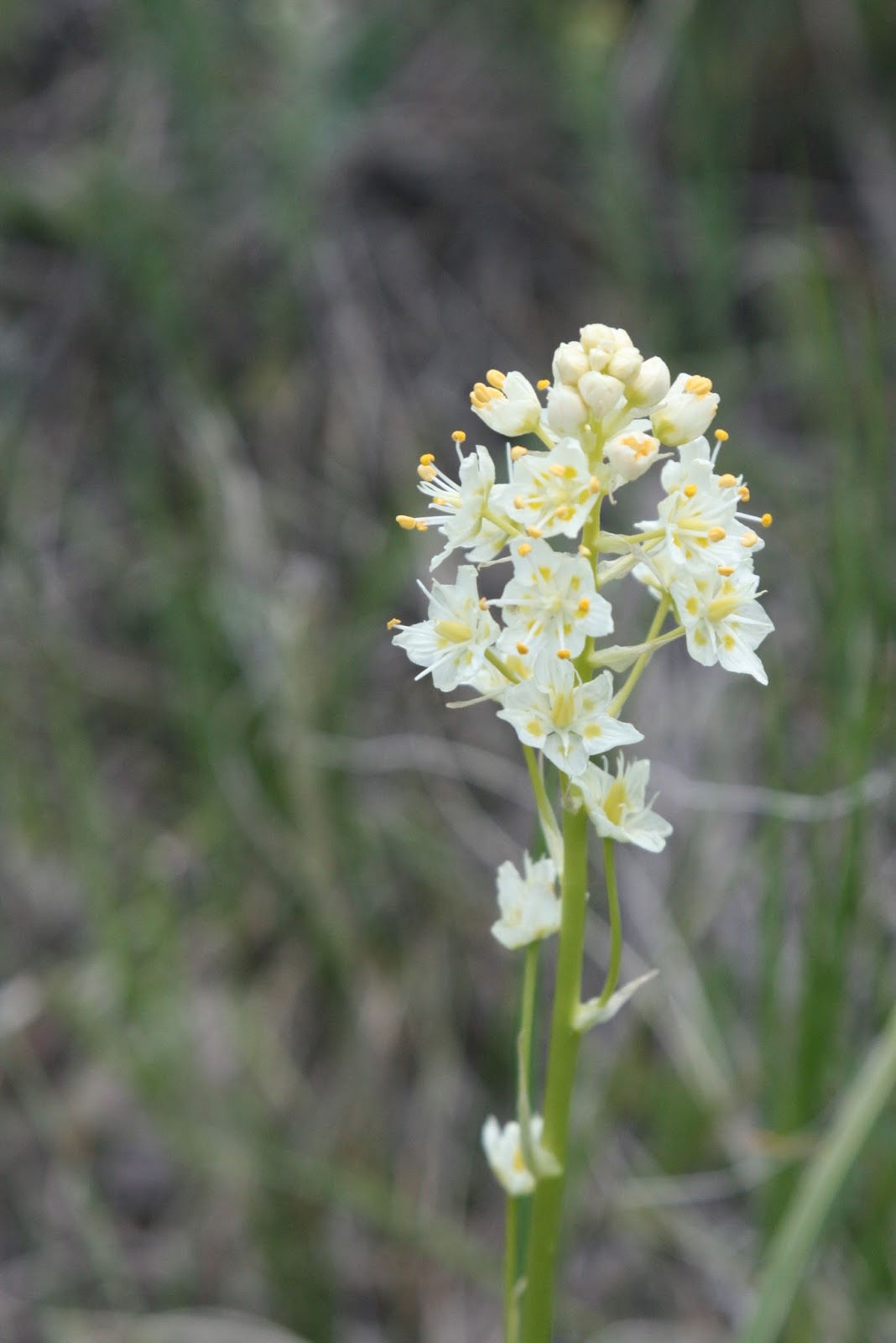
There are many less common flowers blooming that are fun to run across because of their rarity. I've seen a few Death Camas (Tolxicoscordion venenosum) on some northerly exposures.

Get out and take a closer look--you'll be surprised at what you can find!

Sunday, May 10, 2015

Wildflower Hike

The weather has been horrendous for viewing wildflowers and as I write this morning the snow is heavy on the branches of the trees.  Between travel and weather I haven't had a good hike on the mountain in nearly two weeks. but things are looking up and as soon as the warmth returns we should have a spectacular wildflower season.

That brings up a great opportunity. Lakewood Open Space will be hosting wildflower hikes next Saturday morning--that's May 16th at 10:00 at the Florida trailhead off Alameda. If you'd like to pre-register for the hike, go to lakewood.org/bclp and click on "Program and Event Calendar" on the left side. You don't have to pre-register, but that will assure you of a spot and will help us plan.

Locoweed (Oxytropis lambertii)
I did get on the short trail segment between the Florida and Utah parking areas during a break in the rains and spotted at least 25 different wildflowers. The Penstemons and Locoweeds are really coming out now, but some of the early flowers are still blooming, a bit confused by the weather. That means you'll still see Golden Banner and Yellow Violets along the trail.

I'll hope to get out when the trails dry on Tuesday or Wednesday and give you an update.

Prairie Penstemon (Penstemon secundiflorus)

Thursday, April 23, 2015

Fragrant Blooms

The moisture the last two weeks, combined with some travels has made it tough to get out on the mountain, but there's a real treat for you if you do make it out now.  

Three varieties of flowering trees are in bloom on the mountain--Chokecherry (Prunus virginiana), Wild Plum (Prunus americana), and Hawthorne (Crataegus erythropoda). They're full of white blossoms and make the best display of the year for sheer number of flowers.

All three are in the rose family so the individual blossoms look similar. Roses have five petals and many stamens in their native form (including the Wild Rose). Chokecherries have flowers arranged on a stalk (called a spike). Hawthorns have thorns. Of course you can tell them apart later in the year as the fruits ripen, too.
Chokecherry blossom


For the last couple weeks the Wild Plum trees (Prunus americana) have been blooming. If you pass them in full bloom, you'll be able to smell their sweet scent before you get to them. Take advantage of a great weekend and stop to smell the flowers!

Sunday, April 5, 2015

An early Welcome to Springtime

Welcome back to Springtime!  After a warm March, we're seeing wildflowers blooming earlier than ever on Green Mountain. We actually had a decent amount of winter moisture so that may be contributing to the early wildflower show. Normally at the first of April we're just getting started, but there are about 10 species of wildflowers that are blooming already.

Several members of the Pea family are out--Early Purple Vetch (Astragalus shortianus) and Ground Plum (Astragalus crassicarpus). Yellow Violets (Viola nuttallii) and Golden Banner (Thermopsis rhombifolia) cover the hillsides in many areas on the south side.

One of the most spectacular flowers on the mountain is the Mountain Ball Cactus (Pediocactus simpsonii). These small round cactus develop bright pink flowers early in the season and usually only for a couple weeks. There are several blooming on the south side of the mountain. I've never seen them near the parking lots at Florida or Utah, but head up the trails from there (esp Utah) and you'll find them at about 2/3 of the way to the top. There is a nice little cactus garden at one of the switchbacks, and you'll be pleased with the flowers you find!
Mountain Ball Cactus
This is a picture I've used before, but there are some great photo opps for you up the trail!

Saturday, September 27, 2014

Aspens at their Peak

If you have the chance to get up to the High Country this weekend or next you'll see one of the best displays of Aspens in years.  The wet summer has stretched our wildflower season a bit but it's made the aspens healthy and they're showing their gratitude now.

If you look at a hillside of aspens you'll notice that they aren't always the same color.  There will be large patches of gold aspens, but you'll see areas where all the trees are red and other areas where they haven't started turning yet.

Aspens are trees that grow primarily from the spreading of their root system.  If you have any in your yard you may notice lots of little ones coming up around it.  These arise not from seeds, but from the roots.  This process creates large "forests" that are really all one organism.  Although we've just started to understand this cloning process, it appears that aspens form some of the largest organisms
in the world with the largest in Utah, and second largest in Colorado on Kebler Pass.

It's hard to tell exactly where one starts and the next begins, but when you see the big patches of color on the mountainside, salute the largest plants in the state!
Patches of different-colored Aspens cover the hillside

Sunday, September 14, 2014

The end of a confusing summer


What better way to sum up the last half of Summer, but this photo from last week.  Here we are in early September, and a Mountain Ash not only has its bright orange berries, but is blooming again.  Throw on top of that a dusting of snow and you get the picture!  Not only is this Mountain Ash blooming, but we have flowers on a Forsythia, which normally is one of the first shrubs to bloom in the Spring.

Our summer rains have really confused the locals, but it's been great for soil moisture and should make for a great Spring wildflower season.  Many of the years with poorer showings are preceded by dry summers and windy dry winters.  What little snow we did get was blown away or melted quickly without really contributing much to the soil.  The soil is very thin on Green Mountain, so it takes a certain tough species to thrive.  Often you'll find natives growing next to rocks.  The heat they absorb probably helps them get going in the Spring, but also the moisture is funneled down to the roots.

Soil Profile on Green Mountain
In the photo above you can see how the top few inches of soil is darker, enriched by decaying plants.  The soil is still rocky, but there's plenty of room for roots tho thrive.  A soil like this can support many grasses and wildflowers.  If you're familiar with the mountain, though, you know that as you hike the trails you'll come across areas that are all cobbles.  This is an old river channel (more about that another time) that left all its gravel in place.  The soils in these areas is much thinner and it takes specialized plants to colonize it.

Fall is indeed upon us, despite the calendar. Sunday looks like a beautiful Indian Summer day, so I'm planning to get out on the trails and enjoy it!  The rabbitbrush is in full bloom, brightening the hillsides, and for another few weeks (hopefully) we can put off the colder weather!

Sunday, August 24, 2014

Sage Season

One of the most easily recognized plants in Colorado is Sagebrush.  The one we always think of is called Big Sagebrush (Artemesia tridentata).  It has a gray or bluish green cast to it's leaves and a strong odor.  When you burn it, it smells like incense.  It covers miles of open prairie and mountain hillsides in the state, but it doesn't live on Green Mountain.  There may be a few hiding out somewhere, but I haven't found them yet.  

We do have several varieties of sage that keep some color in the hills as all the grass turns to brown.  They're some of the first plants to "green" up in the Spring (some aren't very green) and they keep their color until late Fall. 

They're all flowering now, but it's hard to tell because the flowers are so inconspicuous.  They are about ⅛" across and usually are yellow or white--nothing showy!  
Prairie Sage


Fringed Sage 
 The first two are a grayish green, and look pretty similar until you get close.  Prairie Sage (Artemesia ludoviciana) will grow to over 2' tall.  It has long thin leaves that are a bit hairy if you rub them.  It's cousin is Fringed Sage (Artemesia frigida).  Although the color is about the same, if you check out the leaves, they are very finely divided and look much different than the wider, flat leaves of the Prairie Sage.
False Tarragon
The third sage has a bright green color and can grow up to 4' tall.  Along with many other late Summer bloomers, it doesn't look like much.  The small blossoms are covering g the plants this weekend, and after they bloom they get a really unusual seed pod.  Because they are so inconspicuous, the seeds make it easy to tell False Tarragon.  Of course because it's called FALSE Tarragon, you've probably already figured out that it doesn't have any scent, so you can't replenish your herb jar!
False Tarragon Seed pod

Monday, August 11, 2014

Going to seed

I've been gone for a week--probably a good time of year for that since things don't change much for the wildflower world in the middle of summer.  We've had some decent monsoon rains judging by the rain gauge, and it's kept things from getting too dried out.

But time marches on and we're in the middle of summer.  That means that all the Spring flowers have already gone to seed and lots of the summer flowers are making their seeds, too.  

I've talked about the Aster family and it's composite flowers, but once the flowering ends many of them turn into puffballs like the familiar dandelion seeds.  One thing I didn't quite figured out till i started pulling flowers apart was how they turned into puffballs.  The little umbrellas that carry the seeds on the wind are called pap pus.  When the flower is first forming, they are present, but in the middle of the blossom, all tucked away.  In the photo below I've pulled a few out on the left side. You can see how the individual flowers all extend down so that the seeds are all formed side by side.  As the flower withers, the petals fall away and the pap pus puffs out.  When the wind comes along, they're ready for another invasion of your lawn.  Although you may not like it for dandelions, it spreads seeds very effectively for lots of other native asters, too.

The pea family is another one that makes some interesting seeds.  The Groundplum Milkvetch that we saw earlier in the year gets its name from its seeds, which, as you can see below, look like some kind of weird fruit laying on the ground.  

Groundplum Milkvetch seeds (Astragalus crassicarpus)
On the other hand, Lupine are much more like the typical peas, and grow fuzzy pea pods as the flowers fade.  It's easy to find these since the Lupine are still blooming, so look for a few purple flowers.
Lupine seed pods (Lupinus argeteus)

Monday, July 28, 2014

630 degrees!

What a difference a week makes!  We've seen how quickly flowers start blooming, but when you get 7 days of 90 degrees (7 x 90 = 630, that is!) all the plants start to go into retreat.  Last week I mentioned how the top of the Hayden trail was full of color.  Well, this week things have really quieted down.  Although everything is still blooming, many of the plants don't have as many blooms and some of the color has faded.  Some cooler weather and rain would help.

As I was coming down the Hayden trail I did get one surprise.  On the side of the trail were several Nodding Onions with their purple blossoms nodding in the breeze.  We see Wild all over the mountain early in the year, but these tend to show up in the heat of summer.  The first time I saw them was after the big fire in 2008.  In an area of burned out Mountain Mahogany the Nodding Onions were sprouting, oblivious to the devastation that had just occurred, or maybe even helped by the heat.  The onions pictured below don't have as much color as the ones I saw the other day.
Nodding Onion (Allium cernuum)
When you're out on the mountain this week there are still lots of Purple and White Prairie Clover and Liatris (Gayfeather).  Also providing the gold color to the scene are the Bush and Common Sunflowers, Golden Asters and Curly-tip Gumweed.  Just starting to come out are Rabbitbrush, Goldeneye, and Klamathweed, more gold for the hills!
Gayfeather (Liatris punctata)


Let's hope for some rain and freshen up the mountain!

Tuesday, July 22, 2014

Non-native planting--Mistakes were made...

The other night we were driving home with the windows down and I caught a sweet smell of summer.  It only lasted for a minute before I realized it was Russian Olive.  Too late-- my nose was already plugging up.  I seem to fall for it every year!

Russian Olive is another of the invasive species we've introduced intentionally and now regret.  Although some birds like the olives, the trees are very dense (and thorny!) and crowd out native cottonwoods and willows.  In turn this influences native bird populations.  The last few years I've noticed lots more jays in the area--even eastern Blue Jays.  I don't know much about birds, but wonder what changes we've made to the environment to encourage them.  Although these trees were once sold in nurseries, they're now outlawed and we're encouraged to get rid of the trees.  Easier said than done!


Russian Olive (Elaegnus angustifolia)
A neighbor recommended I mention another non-native, and one that I really enjoy-- Chicory.  It's a weed, but the blue petals in the middle of summer add some needed color on these hot mornings.  Chicory starts blooming about the time flax dies out, and with similar colors it's almost an even trade!  You'll see it blooming in disturbed areas, especially along access roads into the Open Space.

Chicory is a native of Europe, but it's been cultivated in North America because it has edible greens and roots.  The roots are dried and ground to be used as a coffee substitute, and you can still find Chicory coffee as a specialty from New Orleans.  
Chicory (Elaegnus angustifolia)


Tuesday, July 15, 2014

Green Gentians and Mid-summer Color

I've spent the last two weeks in Crested Butte for the Wildflower Festival and the midsummer madness that is Wildflower Season.  While I was up there my tablet decided to quit so I wasn't able to blog.  /the Festival was great.  I lead two wildflower hikes relating the geology to the wildflowers, and a couple other Wildflower Identification hikes.  Any time I get to spend that much time hiking through the woods and meadows, you spot all sorts of interesting things.  

One of my favorite flowers up there, and one that we occasionally see on Green Mountain, is the Green Gentian or Monument Plant.  It's unlike any other gentian, which are usually small purple flowers that bloom in late summer.  This one grows to 6' tall and is covered with four-leafed green blossoms.In mountain meadows you find them blooming fairly commonly, but it's not an easy life for these big showy plants.  

Green Gentians are monocarpic, meaning they flower once and die.  But this flowering happens at the end of a long life, since at high altitudes, or even at our moderate elevation of 6000'+, it takes a long time for the plants to become big enough to flower.  For most of its life, the Green Gentian appears as a bunch of shiny leaves low to the ground.  When it finally has enough strength accumulated, it's bursts forth, producing a shower of seeds to start the cycle over again.  Researchers at the Rocky Mountain Biological Lab (RMBL), in Gothic, Colorado, have watched the same plants as they re-leaf every spring--for over 40 years!  It's thought that many Green Gentians live 60 years before blooming.  Talk about patience!
Green Gentian (Frasera speciosa) waiting patiently
Green Gentian finally blooming!
Now, back to Green Mountain!  After being gone a couple weeks I wasn't sure what the mountain would look like, but it seems the cool (compared to the last few years) summer has kept things looking great.  This year I'mm seeing lots of Purple Prairie Clover, one of my favorites.  When I first saw it several years ago, there was one small patch in a rocky soil in a protected area.  I thought it must be out of its normal range since there was only that small area.  But in the last few years it's spread and this year can be found in many locations.  One of the best is at the top of the John O. Hayden Trail as you contour near the radio tower.  On that stretch the pink Sticky Geraniums, Purple Prairie Clover, Prairie Coneflower and Bush Sunflowers are abundant.  Soon the Liatris (Gayfeather) will add more purple spikes to the landscape.
Purple Prairie Clover (Dalea purpurea) with Golden Asters


Friday, June 27, 2014

Lupine Season

With summer come the Lupine--one of the most celebrated flowers across the country.  In California they're known as Bluebells or Bluebonnets, and in Texas they're the state flower, known as Texas Bluebonnets.  Because they add a bright blue to the scenery as it starts to dry up, they keep Springtime with us for a few weeks longer.

Lupines are members of the  Fabaceae (pea) family.  I've talked about some other members of that family--Vetches, Milkvetches and Locoweed.  Peas are great for the soil since they take nitrogen from the air and 'fix' it in the soil, giving nutrients for other plants.  

Lupines are pretty plants even before they bloom.  The leaves are digitate or palmate, so they come out from one central point like the fingers of a hand.  Early in the season that's all you can see, but they're distinctive, and are a sign that summer will come.
Lupine (Lupinus argentum)
The flowers on peas are pretty cool, too.  They have distinctive names, but mostly it's the over all shape that's important in identifying them.  There are five petals, but the two lower petals are fused into one and form a round, pointed shape which is named a keel.  The two petals on the sideAbove the keel, are two petals that flare out to the side, called wings.  The last petal sits on top and is called the banner.  All peas have a similar arrangement, from the wildflowers to the peas in your garden.  Likewise, after the blooms, the seeds of the Lupine looks like little fuzzy pea pods.  Check them out!

Closeup of Lupine flowers

Friday, June 20, 2014

Some new guys

One of the fun things about tracking wildflowers is that it seems there's always something new.  I've been doing this for 12 years on the mountain, just out of curiosity, but each year I find something new.  Was I just not looking closely, bad timing, or is a nw species looking for a home?

I can answer that question sometimes.  My neighbor said shed found an interesting new plant in the open space behind our houses.  Since that area was scraped for planned development in the '60's, nothing in there is in its original High Prairie condition, so I was suspicious.  Sure enough, the mystery plant is Houndstongue, a noxious weed I'd seen in the mountains, but never down here.  The state has it classified as List B, so although they don't have a plan to eradicate it, they ask anyone who has it on their property to control it.
Houndstongue (Cynoglossum officinale)

The second is much more likable.   Two weeks ago I spayed it near the Utah trailhead, but since then I've found it in three other pace, widely separated, all over the mountain.  This one is called Pony Beebalm, and is a pretty little mint.  
Pony Beebalm (Monarda pectinata)
Keep your eyes open...you never know what'll pop up.

Sunday, June 15, 2014

Microclimates

One of the things that's always fascinated me about Green Mountain is how this 1000' hill can create its own weather.  Numerous times as I'd drive home on 6th Avenue, it would be raining as I got off the freeway, but by the time I had driven another couple miles and gone up a couple hundred feet, we were in a blizzard.

The same thing makes for some interesting places to look for unusual wildflowers.  One of my favorites is Coyote Creek, the name we gave the drainage just west of the water tank at the end of Virginia Drive on the north side of the mountain.  (There were coyote pups being raised there our first summer here.)   This drainage faces north and is steep, so it's well shaded.  It's about the only place on the mountain where aspens, maples and hops can be found.  There are a few others, like False Solomon Seal and Poppy Mallow can be found.  These are usually found higher in the foothills.
False Solomon Seal or Wild Lily of the Valley (Maianthemum stellatum)
There are lots of spots where the wildflowers are more prolific that aren't quite as dramatic as this.  Most of them involve a north-facing slope, so the moisture is retained a little longer in the soil.  Other areas are dry enough to provide a different mini-environment such as some of the exposed areas on the south side where the Mountain Ball Cactus thrive.  Some of these spots are the first to warm up in the Spring, so the early flowers will be out there first.


As far as what's new on the mountain the week, Mariposa Lilies and Prickly Poppies are out in abundance.  These will be around for a few weeks and are some of the most interesting of the summer blooms.  
Mariposa (or Sego) Lily (Calochorus gunnisonii)


Prickly Poppy (Argemone polyanthemos)

Sunday, June 8, 2014

Meanwhile, up in the hills...

I had a chance for a Spring visit to Crested Butte last week, and with the big snows melting off, it looks like a spectacular wildflower season.  This earlier varieties of flowers are shorter, but they are abundant.  The Glacier Lilies and Spring Beauties cover big areas, making the ground yellow and pink.  Things like Columbine aren't blooming yet, but there's lots of larkspur and the lupine are opening up.

The Crested Butte Wildflower Festival will be held July 6-12.  There are lots of planned hikes during that week, but any time in July can be considered the high season for flowers.  If you go, you can pick up information on where to go and wildflower identification guides at the information center in town.
Glacier Lily (Erythronium grandiflorum)
Back on Green Mountain we've seen the first of the sunflower varieties coming out.  This signals the start of the summer flowers to me.  These are members of the Aster Family, and are really complex flowers even though they're so familiar.  Each of the petals lining the bloom is actually a flower in itself, called a ray flower.  Think of the rays of the sun. In the "pincushion" in the center are hundreds more flowers, called disk flowers.  When you see a sunflower with all the seeds in the center, each seed came from one flower.  If you get a magnifying glass you can see that each one has its own flower structure to it.  

Blanketflower is one of the prettiest we have on Green Mountain, and I've see several of them blooming this week.  There are a few Bush Sunflowers, too.  These have centers that are yellow, as opposed to the Common Sunflowers which should be out in a week or two.  Those have dark brown disk flowers.
Blanketflower (Gaillardia aristata)

Sunday, June 1, 2014

The Height of Wildflower Season

The combination of rainfall and sunshine that we've had over the last couple weeks has turbo-charged the wildflower season on Green Mountain.  A couple weeks ago we were having a good season, but were still seeing a lot of the early flowers and barely starting to see things like Penstemon and Locoweed.  In the last few days, the 80 degree temps have brought the mid-season flowers out and the rains have kept the early bloomers intact!

I mentioned that the Wild Onion and Death Camas were kind of hard to find.  Since then I've seen them al over, more onions than camas, but if you look closely for the little guys there are lots of them around.  

One of the other wildflowers we don't see too often on the mountain is going wild this year.  These are the Spiderworts, which are blooming in big healthy plants on the south side of the mountain. These are great flowers for your garden, too.
Western Spiderwort (Tradescatia occidentalis)
The following is a quick list of some of the more prominent wildflowers blooming this week on Green Mountain.  I spotted 79 species in a couple hikes and runs on the mountain, but these are the ones you're most likely to spot by color and common name.

Blue:  Blue Mist Penstemon; Chiming Bells; Flax;
Purple: Silvery Lupine; Spiderwort
Magenta: Locoweed
Orchid: Orchid Beardtongue Penstemon;
Pink: Sticky Geranium; 
Yellow: Golden Banner (a few left); Bush Sunflower; Butter and Eggs (Toadflax); Leafy Cinquefoil (looks like Potentilla); Whiskbroom Parsley
White: Drummonds Milkvetch; Prickly Poppy; Wild Onion; Mouse Ear Chickweed;

Those are a few of the most prominent--lots more to see!

Sunday, May 25, 2014

Lilies in the Fields

The plant world is divided into many parts, but the first main divisions between Gymnosperms (pines and the like) and Angiosperms, plants with fruits enclosing their seeds.  Of the Angiosperms we have monocots and dicots.  The monocots are mostly grasses but also include things like onions and lilies.  These are the plants I'll talk about today.  

The term monocot refers to the way the plant starts growing.  When you picture the beans or morning glories coming up in your garden, the first leaves (or cotyledons) that grow from the stem are in pairs.  That's a dicot--two cotyledons.  The monocots have only one leaf that comes out of the seed--like a grass.  Lilies, onions and grass all grow that way.  In addition, when their leaves are larger they are long and have veins that are parallel to the length of the stem.  Dicots can have really complicated leaf structures--picture an oak or maple leaf.

I've talked about Sand Lilies (Leucocrinum montanum), one of the harbingers of Spring (See April 13 entry).  Last week I saw a less common, but really cool little lily blooming--Meadow Death Camas (Toxicoscordion venous).  I've never seen these near a trail, always in the untrammeled meadows on the mountain.  As the name implies, they are poisonous, but pretty little flowers.
Death Camas (Toxicoscordion venous)
I haven't seen any onions yet this year, but they should be coming out soon.  They're a small, chive sized plant that grows all over the mountain, but you'll have to keep your eyes peeled for it.  This one is Allium textile, aka Wild Onion.  Later in the year you might see a Nodding Onion (Allium cernuum).  These have flower umbels that fall over, or nod, and the flowers are a light pink or lavender color.  
Wild Onion (Allium textile)
I haven't ventured out into the muddy Open Space since the storms of last Saturday night.  Hopefully they didn't beat up the wildflowers too much--we were off to a great start!